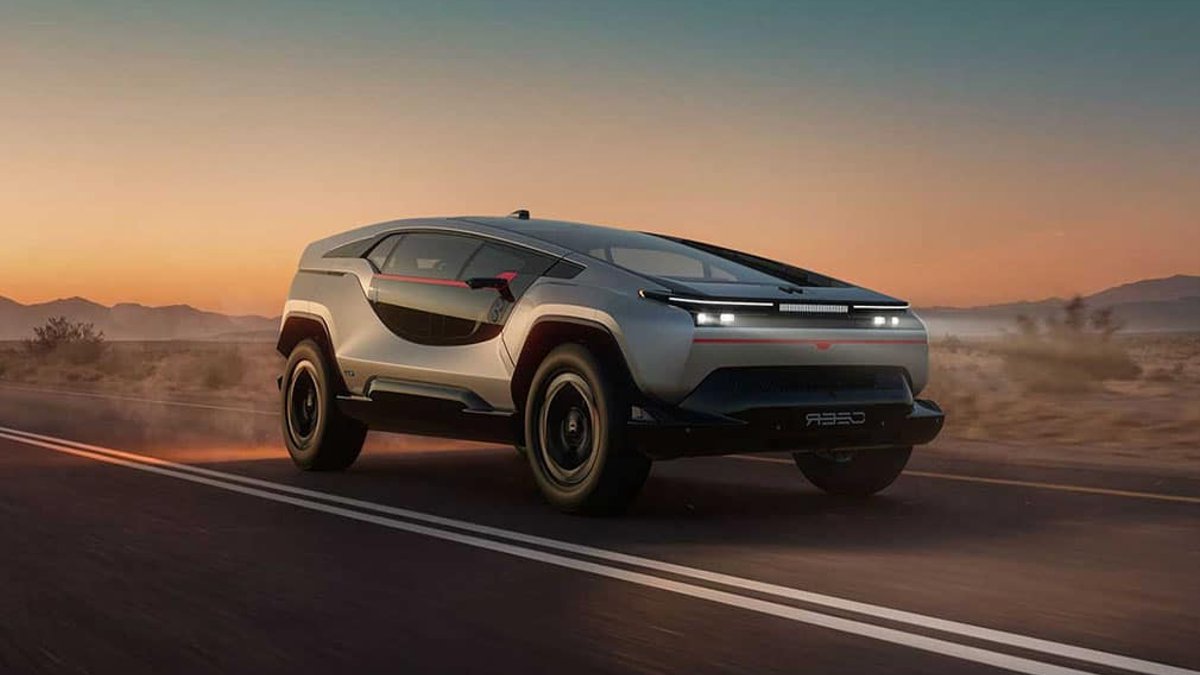
The Ceer Exobot represents Saudi Arabia’s first complete electric vehicle lineup, and the automaker has now shared detailed specifications covering performance, range, and design—moving past the initial teaser phase. The lineup comprises a saloon and an SUV, both equipped with up to 850 horsepower in their launch versions, an 112kWh battery, and an 800V electrical system. The saloon is advertised with a 670km (416 miles) range, though this figure includes a significant qualification.
The Exobot’s styling adopts a heavily futuristic direction, featuring a windscreen measuring 2.4 meters wide and Shahin Wing doors that open nearly three meters wide while removing the traditional B-pillar. Ceer’s CEO, Jim DeLuca, stated that structural integrity is preserved through advanced materials, though no independent crash-test results have been published. The SUV, shorter but taller than the saloon, provides 300mm of ground clearance and a 402-liter boot. Both models incorporate rear-wheel steering and adaptive air suspension.
The First Edition, serving as the launch model, delivers 850hp and 1,000Nm of torque via three motors and all-wheel drive, achieving 0-100km/h acceleration in 2.6 seconds for the saloon and 2.9 seconds for the SUV. Ceer has also outlined a higher-performance variant with 1,111hp and 1,500Nm, capable of 0-100km/h in 2.1 seconds for the saloon and 2.4 seconds for the SUV. Early reports occasionally conflated these performance figures with the First Edition’s battery and range specifications, creating confusion about the car’s capabilities.
Range and charging claims under scrutiny
The 112kWh NCM battery paired with the 800V architecture enables a claimed 10-80% charge in under 30 minutes, though Ceer has not revealed the peak charging power. The saloon’s 670km (416 miles) range is based on the older NEDC standard, which generally overestimates real-world performance compared to the WLTP cycle used in Europe and the UK. Without a published WLTP figure or independent testing, the actual range remains speculative.
Robert Melville, formerly of McLaren, leads Ceer’s design team, which has emphasized bold proportions and engineering innovations. The SUV stands 1,693mm tall, while the saloon measures 5,260mm long—dimensions suggesting adaptation to Saudi conditions rather than compact European parking spaces. Inside, the cabin includes a 48-inch curved Digital Horizon display, a steering yoke that reduces turning input from 400 degrees to 160 degrees, and a climate system called Halo Cooling. This system claims to lower interior temperatures from 65°C to 32°C in 10 minutes, addressing the region’s extreme heat.
The Exobot’s safety features, while ambitious, lack independent verification. Ceer highlights cell-to-pack battery construction, seven airbags, and advanced driver assistance, but no Euro NCAP results or crash-test data have been released. The absence of a B-pillar raises concerns about structural rigidity, particularly in collisions.
Global rollout plans and regulatory hurdles
Sales in Saudi Arabia are set to begin in early 2027, with regional expansion planned for 2028 and broader Middle East and North Africa markets to follow. There is no confirmed UK launch, pricing, or delivery date, though later models are being designed to meet global regulations. The brand’s strategy suggests potential European entry, but the Exobot’s right-hand-drive compatibility remains unconfirmed.
Ceer’s collaboration with Foxconn and Rimac Technology, alongside licensed components from BMW, reflects a hybrid approach combining Saudi manufacturing with global supplier expertise. The company plans to launch seven models by 2030, with five mainstream vehicles between 2028 and 2030. The Exobot is just the first step in this expansion.
The SUV model includes rear-wheel steering adjustable up to 6.5 degrees to improve maneuverability. Both vehicles retain physical controls for critical functions, alongside over-the-air software updates. The infotainment system supports Arabic and English voice commands, while the SoundStage audio system integrates cabin surfaces into the speaker array for enhanced sound quality.
Futuristic design meets real-world practicality
Despite its futuristic appearance, Ceer has emphasized practicality in its design choices. The Halo Cooling system, for example, combines front and rear air conditioning with triple silver-coated glass and airflow management to rapidly reduce interior temperatures. The switchable lower door glass allows occupants to adjust transparency for light or privacy, while the 2.4-meter windscreen, inclined at 15 degrees, contributes to aerodynamics. The Shahin Wing doors, however, remain questionable in real-world usability, particularly in narrow garages or dusty environments.
Ceer has not disclosed a retail price for the Exobot, though the First Edition is available in 2027 for the Saudi market. The company offers a six-year or 200,000km warranty on the vehicle and an eight-year or 200,000km battery warranty, along with six years of scheduled servicing and roadside assistance. A home charger installation allowance of up to SAR 2,000 is included, but these terms apply only to Saudi customers. No pricing, launch date, or delivery timeline has been confirmed for the UK or Europe.