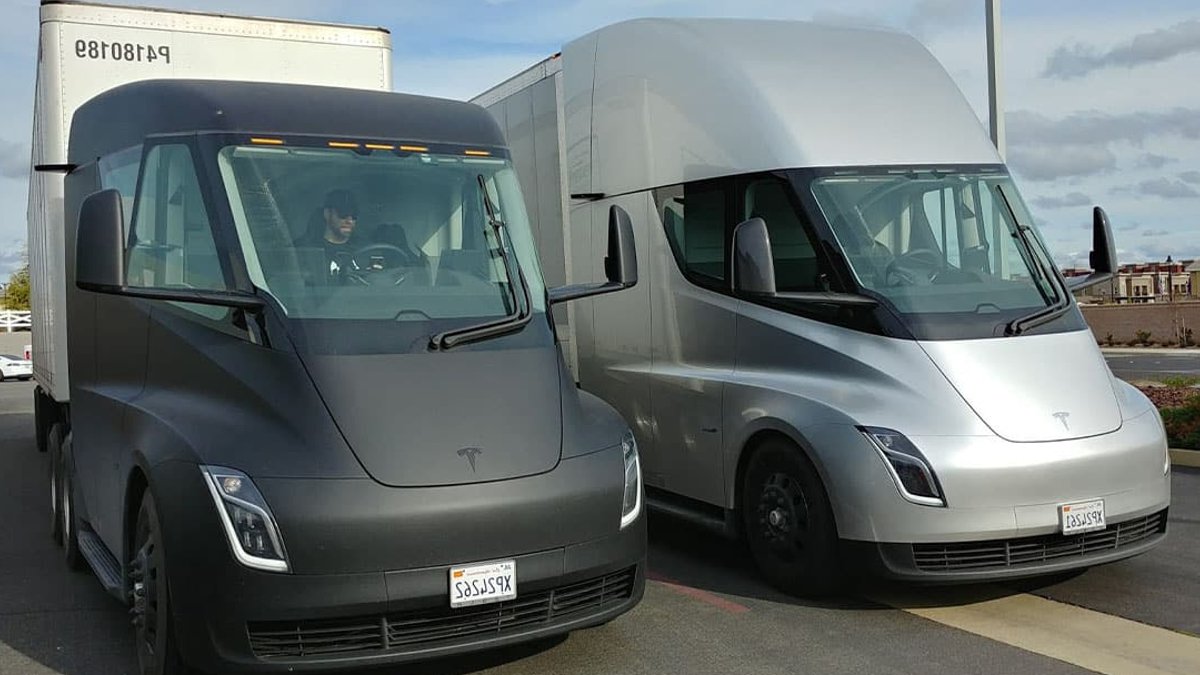
Tesla has taken a significant step towards making its Semi truck a reality in the UK by updating its website with European specifications. The new webpage lists key details such as an estimated range of 550km, an 800kW charging capability, and energy consumption of 1.0kWh per kilometre. Additionally, the truck will feature an MCS 3.2 charging connection. According to IAA Transportation, Tesla is set to announce European specifications and launch details at the Hannover show, which will take place from 15 to 20 September 2026.
UK Hauliers Still Can’t Order Tesla Semi
Despite this progress, British hauliers are not yet able to place an order for the Semi. The UK webpage currently only offers a “Get Updates” form, with no information on pricing, order dates, or delivery timelines. Furthermore, the Semi is not listed on the UK government’s eligible truck grant page as of 12 September 2026. As a result, the question of when the Semi will be available for purchase in the UK remains unanswered, with Tesla’s official stance being that no announcement has been made.
The timing of the Hannover show is opportune for those interested in the future of electric heavy trucks. IAA Transportation has confirmed that Tesla will showcase the Semi at the event, allowing attendees to take test drives. The show’s press day is scheduled for 14 September, and the public exhibition will run from 15 to 20 September. For fleet operators, the Hannover show promises to provide valuable insights into the launch timing, market availability, charging infrastructure, and pricing of the Semi.
It’s worth noting that battery-electric trucks currently make up only a small fraction of Britain’s HGV fleet. In 2025, the Society of Motor Manufacturers and Traders recorded 587 new zero-emission HGV registrations, representing a 170.5% increase, but still only 1.4% of the new HGV market. In the first quarter of 2026, uptake remained below 1%. Electric trucks are growing rapidly, but from a relatively small base.
Tesla’s entry into the European market comes after established truck manufacturers have already made significant strides in the electric HGV sector. Companies like Mercedes-Benz, Volvo, DAF, MAN, and Renault Trucks have electric HGVs operating in Europe and Britain. As a result, the Semi will not be able to define the category solely based on its brand recognition.
European Launch Details Coming to Hannover
A UK launch for the Semi appears plausible, but it has not been fully confirmed. The strongest indication of a potential launch is the existence of a dedicated UK Semi product page with European-style metric specifications and a form for updates. Reuters reports that Tesla is moving into the European market, while IAA Transportation states that European launch details will be announced in Hannover.
However, several key pieces of information are still missing. There is no UK list price, no live UK configurator, no order-opening date, no British customer-delivery date, and no published UK service or Semi charging map on the product page. This lack of information is why the Tesla Semi cannot be considered “on sale in Britain” at this time. The presence of a localized webpage is a positive sign, but it is not a guarantee of availability.
Related Post: Saudi electric cars debut with extreme power and futuristic design
Specs and Real-World Range Considerations
Tesla quotes an estimated range of approximately 550km, or about 342 miles, for the Standard Range Semi. This figure is reported at a 40-tonne gross combination weight, which is significant because an electric tractor unit without a meaningful load would not provide a realistic representation of the truck’s capabilities. As with any estimate, various factors such as temperature, speed, gradients, wind, trailer aerodynamics, tires, and payload can all impact the truck’s consumption.
A headwind that might be mildly annoying in a hatchback can become a significant issue for a heavy truck with a large frontal area. Since Smart Motoring has not conducted a road test of the European production Semi, there is no independent range figure available. The current position is that Tesla claims a range of about 550km under its stated European specification, and real-world European fleet data is still needed to confirm this.
Charging Integration and Future Infrastructure
Tesla lists MCS 3.2 as the charge type for the European Semi. MCS stands for Megawatt Charging System, a heavy-duty charging approach developed through CharIN and the wider standards community to support high-power conductive charging for electric trucks and other large vehicles. This is strategically important, as it suggests the European Semi is not being positioned around a Tesla-only physical charging connector.
CharIN describes MCS as a common solution for heavy-duty vehicles, with a design envelope that exceeds current passenger-car charging currents. While standardization does not guarantee that every MCS truck will automatically take full power from every MCS charger, it reduces the risk of Europe ending up with expensive truck chargers that only work with one brand. Vehicle voltage, current limits, software, site power, and thermal conditions still play a key role in determining charging capabilities.
Understanding the 800kW Charging Capability
Tesla‘s business charging hardware can deliver up to 1.2MW, but the European and UK Semi page states that the truck is 800kW charge capable. These statements do not conflict, as the charger can deliver more power than the vehicle requests. The truck’s battery state, battery temperature, and charging control system determine how much power flows at any given moment.
For the European Semi, the published vehicle-side number is 800kW. Describing the truck as 1.2MW-charging because Tesla sells a 1.2MW charger would be incorrect, similar to describing a 150kW family EV as a 350kW car simply because it is plugged into a 350kW public charger. Tesla claims that the Semi can recover up to 60% of its range in 30 minutes using Semi Chargers, which is a more useful operational claim, although the company has not published a European charging curve showing how long the truck holds peak power.