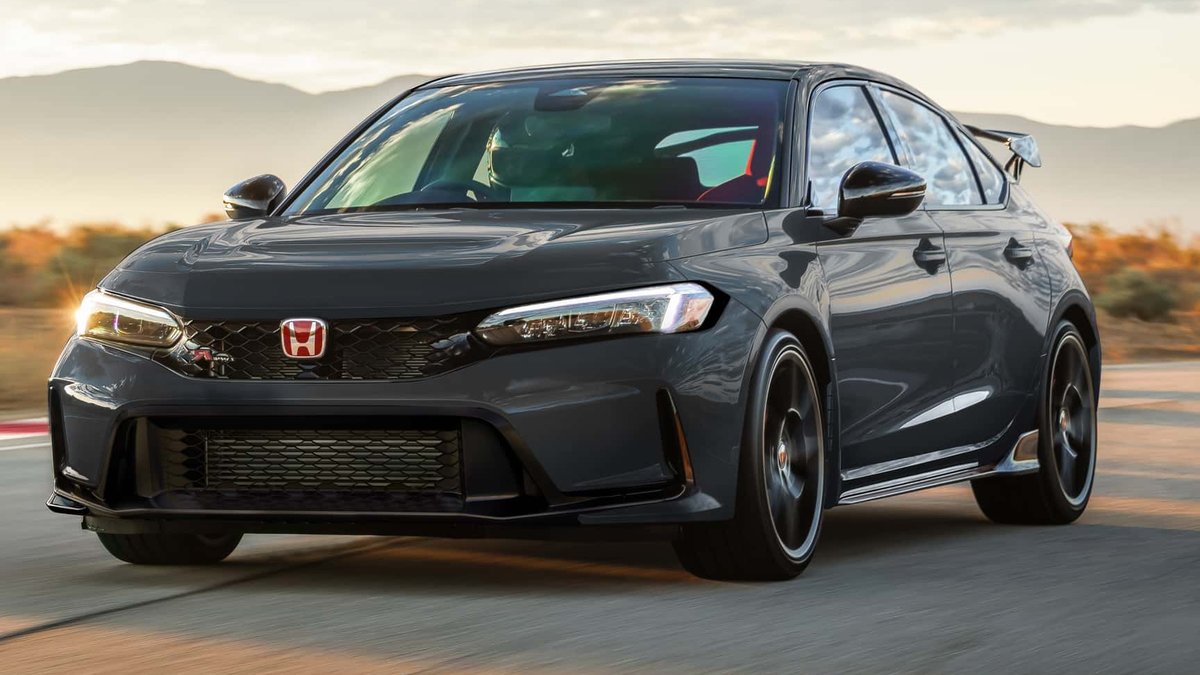
The 2027 Honda Civic Type R debuts in the United States this month, blending sharper performance with greater practicality. The model’s European production ends, however, due to tightening emissions standards. Honda’s updates concentrate on aerodynamic efficiency, handling precision, and driver engagement, alongside new standard features that were once optional extras.
Aerodynamic refinements begin at the front, where a larger grille opening and a deeper front splitter reduce engine bay turbulence. These changes help the 2.0-liter turbocharged engine maintain cooler operating temperatures during demanding driving. The splitter also generates additional downforce, correcting what Honda identified as an underwhelming aerodynamic balance. Inside, the suspension’s damping in +R mode has been reengineered to enhance stability on the road while softening the jarring feedback during aggressive cornering maneuvers.
The braking system also receives upgrades, with a yoke spring added to the pedal linkage to eliminate free play and sharpen feedback. Engine response during downshifts is now quicker, thanks to refined rev-matching—a critical refinement for a car that retains its manual transmission. These mechanical adjustments preserve the Type R’s classic driving character while correcting areas where it had previously fallen short.
Exterior styling remains largely unchanged, but the 2027 model introduces Meteorite Gray Metallic as a new paint option. Inside, heated front seats are now standard, and the cabin features Ultrasuede on the upper dashboard and door panels, alongside diamond-pattern trim for a more upscale appearance. Darker aluminum accents on the shift knob, center console, and door handles pair with black-finished climate controls to raise the interior’s aesthetic.
Related Post: Honda Accord still a daily driver after 50 years
Functionality has improved with the addition of two USB-C ports above the existing wireless charging pad. Safety features expand to include an auto-dimming rearview mirror, upgraded adaptive cruise control, lane-keeping assistance, and a new post-collision braking system. For the first time, the Type R integrates Google services, offering built-in Maps and Play functionality. These additions make the car more suitable for everyday use without compromising its performance-focused identity.
The starting price increases to $49,990, a $1,300 rise from the previous year’s model. The refreshed Type R will arrive at dealerships alongside its direct competitor, the Volkswagen Golf GTI/R.
The Civic Type R’s withdrawal from European markets stems directly from regulatory pressures. Honda cited compliance with stricter emissions legislation as the reason for discontinuing production, a challenge that also affects other performance models such as the Toyota GR86 and Subaru BRZ. The discrepancy between the U.S. and European versions shows how regulatory differences can determine which cars remain available—and which are phased out.
For European enthusiasts, this development adds to a broader trend of disappearing affordable performance cars. Mazda’s MX-5 Miata, for example, lost its 2.0-liter engine due to similar regulatory constraints, leaving fewer options for drivers who prioritize driving enjoyment over advanced technology.