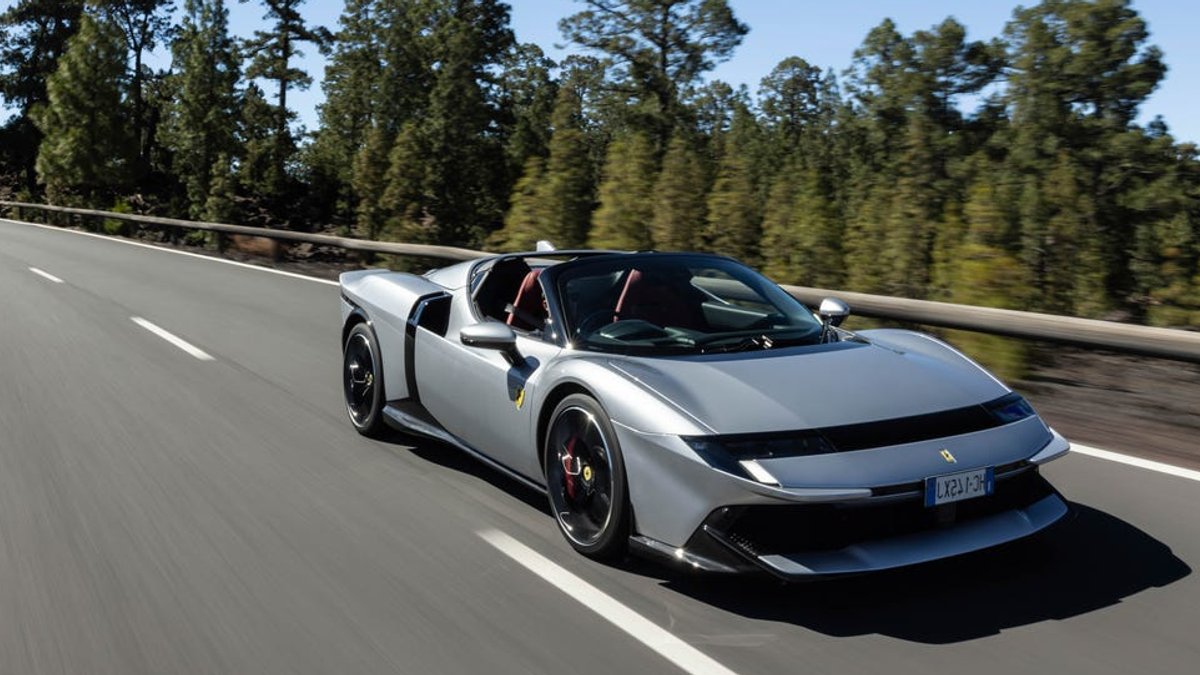
The Ferrari 849 Testarossa and its Spider variant are cars that, despite their many talents on the road, leave questions about their naming and design choices.
The 849 designation breaks from Ferrari’s usual naming system, which typically combines engine size and cylinder count. Instead, the number reflects eight cylinders and 499 cc per cylinder, a shift that feels contrived. The Testarossa name, beyond its red valve covers, lacks any real connection to its predecessors—no styling cues, mechanical references, or Easter eggs link it to the original Testa Rossa racer or the 1980s Testarossa.
Related: India plans 1,000 manure fuel plants after Suzuki
The design also draws mixed reactions. The cabin closely resembles the SF90’s, making the car look like an updated version of an older model. A black bar across the front attempts to mimic pop-up headlights, though none exist. From the outside, the car struggles to fully commit to its new identity.
The interior, however, offers a much better experience. The seats are comfortable, legroom is adequate, and the digital gauge cluster is controlled by physical buttons on the steering wheel. The red start/stop button stands out as a rare physical feature among mostly digital controls. Even the mirror and climate adjustments, though digital, feel less intuitive than older, tactile designs.
The powertrain stands out as the car’s strongest feature. The 4.0-liter twin-turbo V-8, now with larger turbos, generates 819 horsepower and 621 lb-ft of torque. A smart blow-by system in the cylinder head reduces turbo lag, a common issue in high-performance turbocharged engines. Combined with three electric motors—one 201-hp unit between the engine and gearbox and two 133-hp motors powering the front wheels—the system produces a total of 1,036 hp.
Related: Russell fights back as Antonelli leads in Austria
Steering remains precise without being overly sensitive. The front electric motors adjust torque mid-corner to enhance handling without feeling intrusive. The two-piece hardtop retracts quickly, even at speeds up to 30 mph. With the roof down, the experience improves, though a slight structural flex—a minor jiggle—serves as a reminder that this isn’t a carbon-fiber tub. The digital gauge cluster, while customizable, can’t show both a tachometer and navigation at the same time, a frustrating limitation during spirited drives.
Ferrari suggests an aftermarket exhaust to unlock the engine’s full sound. The stock system, limited by particulate filters, is quieter than the F8’s, despite producing 50% more power. An Akrapovič setup costs $15,000, an expensive addition for a car already priced in the seven figures.
Related: July inspired lab diamond engagement rings
Despite its engineering, the 849 Testarossa Spider faces tough comparisons. Opinions on the styling will differ. Some will admire the 849 Spider’s look, especially in Argento Nürburgring. Others will find its proportions awkward. What’s clear is how well it drives—fast, balanced, and surprisingly practical, even in slow traffic.
At least it won’t be confused with a 296.