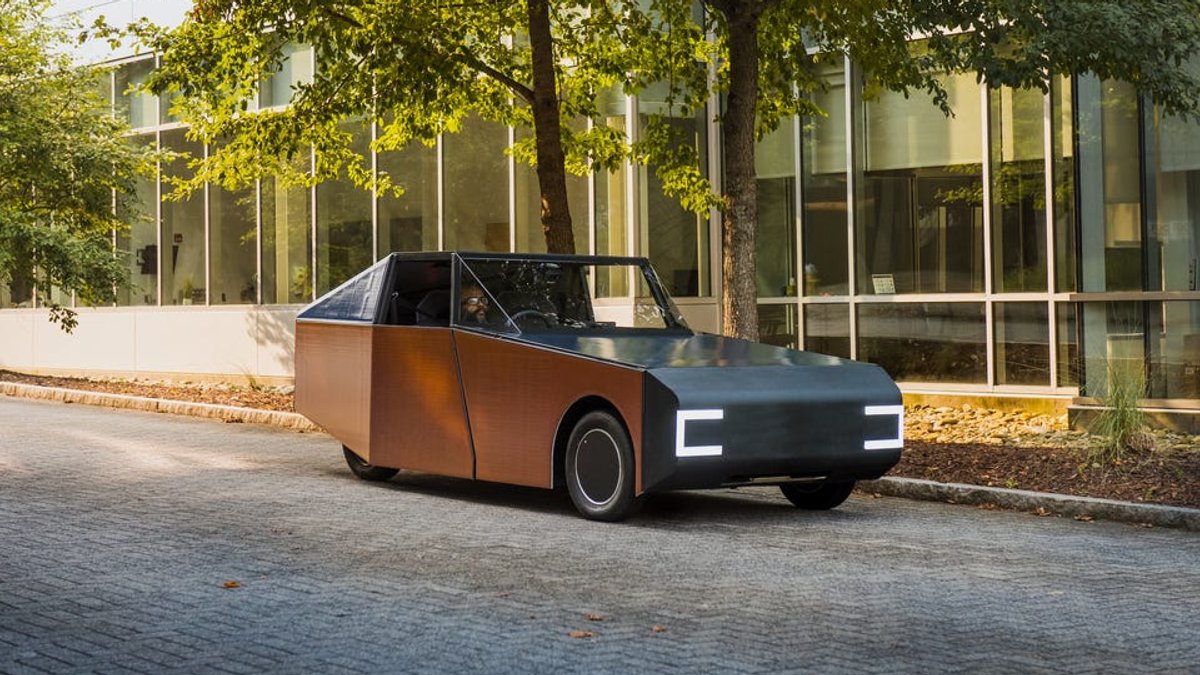
Clemson University students have developed a solar-powered concept vehicle, Deep Orange 17, with BMW, which can generate more energy than it consumes during a typical day of driving. The prototype is the latest vehicle created through the university’s Deep Orange program, an industry-backed initiative that gives graduate automotive engineering students the challenge of designing and building a fully functional concept vehicle from the ground up.
The challenge came directly from BMW, which asked the students to look beyond simply extending EV range or improving charging speed, but to answer a bigger challenge: Could an electric vehicle produce more energy than it uses during everyday commuting?
A Solar-Powered Vehicle
The answer is the two-seat Luminetta, a compact electric coupe covered with more than 1,700 photovoltaic cells integrated directly into its bodywork. Unlike rooftop solar panels tacked on as an afterthought, the system is a core part of the vehicle’s propulsion strategy, generating electricity both while the car is parked and while it’s being driven.
Related: Ford unveils affordable electric pickup Fathom
Working with Fraunhofer Institute for Solar Energy Systems out of Germany, the team developed solar panels capable of continuing to generate electricity even when portions of the vehicle are shaded. Using simulations based on weather and sunlight conditions in Greenville, South Carolina; Frankfurt, Germany; Madrid, Spain; and Mumbai, India, they found that a driver traveling about 12 miles per day could generate enough surplus solar energy to add an average of roughly 31 miles of driving range beyond what was consumed during the commute.
Efficiency Measures
Achieving that goal required far more than solar panels. For starters, Deep Orange 17 weighs in at just 1,212 pounds, and is roughly one-quarter the weight of many production electric vehicles. Its chassis combines steel, aluminum, carbon fiber, and 3D-printed metal components to maximize strength while minimizing mass.
The team says the body itself was inspired by the surprisingly aerodynamic shape of the boxfish, a design approach the engineers say reduces drag while maintaining interior space. Other efficiency measures include regenerative braking, intelligent torque management, and optimized drivetrain controls.
Related: Felix Rosenqvist Discusses Return to Arrow McLaren
Several automakers, including Mercedes-Benz, Hyundai, and Lightyear, have played around with solar-assisted electric vehicles, though mostly with the use of rooftop solar to power accessories or provide modest range gains. Deep Orange 17 pushes the concept considerably further by making solar generation central to the vehicle’s energy balance.
Future Development
BMW, a longtime partner of Clemson’s Deep Orange program, says the project demonstrates how lightweight engineering, renewable energy and intelligent vehicle controls can work together to rethink personal transportation. Research on the prototype will continue at Clemson, and the vehicle is scheduled to appear at CES 2027 in Las Vegas.
Meanwhile, the 16 grad students who spent the past two years designing and building Deep Orange 17 will graduate this week with master’s degrees in automotive engineering—and with experience developing a vehicle from concept sketch to running prototype.