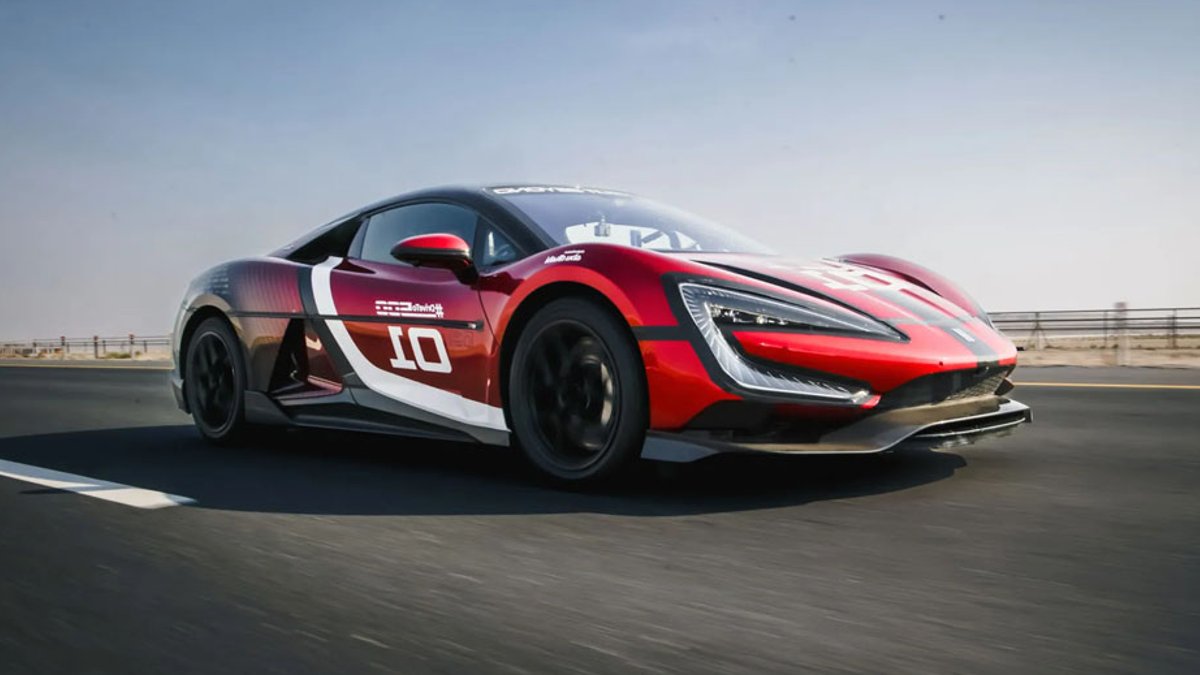
A landmark moment arrived in the automotive industry as the BYD Yangwang U9 Xtreme shattered the 500-km/h barrier, marking the first verified single-direction speed record for a production vehicle. On November 1, 2026, in Abu Dhabi, the Chinese electric hypercar hit 312.65 mph (503.17 km/h) with professional driver Marc Basseng at the controls, cementing its place in speed history.
The record took place on a restricted stretch of Sheikh Khalifa Bin Zayed International Road within Abu Dhabi’s Al Dhafra region. Authorities closed about 6.2 miles of highway, creating a straight section measuring roughly 4.3 miles for the high-speed attempt.
Record-Breaking Run
Yangwang engineers first tried twice on October 31, hitting around 304.5 mph but missing the 500-km/h goal. Instead of accepting that amazing speed, they spent the night optimizing the setup, tweaking the aerodynamic balance, changing the rear wing, and adjusting tire pressures.
When testing resumed on November 1, the second run finally delivered the breakthrough, recording 503.17 km/h and surpassing the vehicle’s previous 308.34-mph achievement in Germany from September 2025. The Fédération Internationale de l’Automobile (FIA) has formally recognized the result, giving BYD and its luxury Yangwang brand a legitimate reason to celebrate.
The BYD Yangwang U9 Xtreme uses four independently controlled electric motors producing a combined output of approximately 2,977 horsepower. Each motor contributes roughly 744 horsepower, giving the car more than twice the output of the already impressive standard U9. The powertrain operates on an advanced 1,200-volt electrical architecture, allowing the vehicle to deliver enormous amounts of power while managing the electrical and thermal demands associated with extreme acceleration.
Engineering Challenges
One of the most interesting parts of this success involves the tires. Producing nearly 3,000 horsepower is impressive, but putting that power onto the road safely at over 300 mph presents a distinct engineering challenge. Yangwang worked with Giti Tire to create specialized semi-slick tires built to handle the huge centrifugal forces and heat generated at these speeds.
At 312 mph, even small tire issues could have disastrous results, making this one of the most key parts of the project. It reminds us that breaking top-speed records needs more than just adding horsepower. The connection between the tires and wheels was also carefully designed to reduce unwanted movement during extreme acceleration and braking.
The U9 Xtreme’s 312.65-mph achievement was recorded in a single direction rather than as an average of two runs in opposite directions, the latter being the traditional standard used for certain production-car speed records. That difference matters because wind conditions and road gradients can influence results. Nevertheless, the FIA recognized the measured speed, and the car earned two Guinness World Records, one for the highest speed achieved by a production car in a single-direction run and another specifically for an electric production car.
The same hypercar specification previously recorded a Nürburgring Nordschleife lap time of 6 minutes and 59.157 seconds, setting a production electric vehicle lap record around the legendary German circuit. That’s particularly noteworthy because building a car capable of reaching 312 mph is not necessarily the same as developing one that can corner, brake, and handle the constant elevation changes of the Nürburgring.
Yangwang has shown both abilities, proving its extreme powertrain is backed by serious chassis engineering, sophisticated suspension technology, and significant aerodynamic development. The company intends to build only 30 examples of the Yangwang U9 Xtreme globally, making this an exceptionally rare machine for a very select group of customers.
The development of the U9 Xtreme has progressed at a remarkable pace, with the original U9 reaching approximately 192 mph in early 2024 before advancing to nearly 244 mph later that year. By August 2025, the more extreme version had reached 293.5 mph, followed by 308.34 mph just one month later. Now, barely a year after that achievement, the company has crossed 312 mph, illustrating just how aggressively Chinese manufacturers are investing in high-performance electric vehicle technology.
The U9 Xtreme’s record-breaking run is a result of the company’s aggressive investment in high-performance electric vehicle technology.